How to Choose the Right Ring Size: Your Ultimate Guide
July 14, 2026 16 min read 3,102 words
Unlock the secrets to a perfect fit, ensuring comfort and confidence for every cherished piece of jewelry.
Find Your Perfect Fit
Understanding the Nuances of Ring Sizing
 Photo: Sandin Redzo / Pexels
Choosing the right ring size is far more intricate than simply picking a number; it's an art that balances comfort, security, and the unique characteristics of your finger and the ring itself. Many factors conspire to influence your finger's exact dimensions, leading to a dynamic measurement that can shift throughout the day, across seasons, and even over the years. Ignoring these variables is a common pitfall that can lead to discomfort, loss, or the hassle of resizing.
First, let's delve into the daily fluctuations. Your fingers tend to swell slightly in warmer temperatures, after physical activity, or even after consuming salty foods. Conversely, they can shrink in colder weather or during periods of dehydration. This means that a ring that fits perfectly on a cool morning might feel uncomfortably snug by a warm afternoon, or vice-versa. For this reason, experts often recommend measuring your finger multiple times throughout the day and on different days to establish an average. The best time to measure is typically at the end of the day when your fingers are at their largest, and you should aim for an average temperature, avoiding extreme heat or cold.
Seasonal changes are another significant consideration. In summer, due to higher temperatures and increased hydration, fingers are generally larger. In winter, they tend to be smaller. If you're purchasing a ring that you intend to wear year-round, it’s crucial to find a size that accommodates both extremes without being too loose or too tight. A good rule of thumb is to aim for a size that feels snug but comfortable in mild conditions, allowing for slight expansion and contraction.
Beyond these environmental factors, individual physiology plays a role. Weight fluctuations, pregnancy, and certain medical conditions can all impact finger size. Over time, knuckles can also enlarge, making it harder to slide rings on and off, even if the base of the finger remains the same size. This highlights the importance of not only measuring the base of the finger but also ensuring the ring can comfortably pass over the knuckle without excessive force or feeling overly loose once it's on.
The style and width of the ring itself are critical, often overlooked, elements. A thin, delicate band typically requires a different size than a wide, chunky one. Wider bands cover more surface area of the finger, creating a tighter sensation. As a general rule, for bands that are 6mm or wider, you might need to go up a half size, or even a full size, compared to your measurement for a narrow band. This is because the surface area of contact with the skin is greater, and the finger cannot compress as easily. Similarly, rings with a comfort fit (a slightly domed interior) often feel looser than standard fit rings of the same size, sometimes allowing you to size down a quarter or half size.
Furthermore, the material of the ring can subtly influence the perceived fit. While a metal ring's size is a fixed diameter, the density and finish can affect how it glides over the skin. For example, a highly polished, smooth interior might feel slightly less restrictive than a brushed or textured one. Understanding these nuances is the first step in mastering how to choose the right ring size, ensuring your chosen piece is a joy to wear for years to come. For more insights into selecting the perfect adornment, explore our guide on
how to choose the right jewelry for any occasion.
Accurate At-Home Ring Measurement Techniques
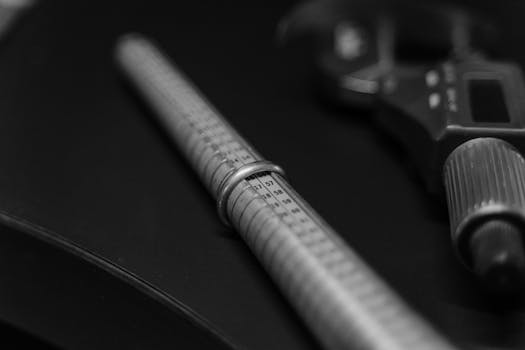 Photo: Tima Miroshnichenko / Pexels
While professional jewelers offer the most precise measurements, knowing how to choose the right ring size at home is invaluable for initial estimates, online shopping, or even a surprise proposal. Several reliable methods can help you get a good approximation, but remember to follow best practices for accuracy.
The 'string or paper strip' method is one of the most common and accessible. To perform this, take a non-stretchy piece of string, dental floss, or a strip of paper (about 1/4 inch wide) and wrap it snugly around the base of the finger where the ring will sit. Mark the point where the string or paper overlaps. Then, unwrap it and measure the length from the start to the mark with a ruler, preferably in millimeters for greater precision. This measurement corresponds to the inner circumference of the ring. You can then compare this circumference to a standard ring size chart, which can be easily found online. A crucial tip here is to ensure the string or paper is tight enough to represent the ring's fit but not so tight that it constricts your finger. Also, make sure it can slide over your knuckle comfortably. If your knuckle is significantly wider than the base of your finger, measure both and choose a size that can pass the knuckle but isn't too loose on the base.
Another effective at-home technique involves using an existing ring that fits well on the intended finger. If you have a ring that is already the perfect size, you can measure its inner diameter. Place the ring on a ruler and measure the inside edge from one side to the other. Again, converting this measurement to millimeters and comparing it to a ring size chart will give you your approximate size. This method is particularly useful if you're trying to secretly determine someone else's ring size, as it doesn't require direct interaction with their finger. However, ensure the existing ring is a standard band and not a comfort-fit or unusually shaped ring, as these can skew measurements.
Printable ring sizers are another excellent resource. Many online jewelers and jewelry guides offer free, printable ring sizer templates. These usually involve printing a chart to scale and either cutting out a paper sizer to wrap around your finger or placing an existing ring on top of various circles to find a match. When using a printable sizer, it is absolutely critical to print it at 100% scale. Any scaling issues will lead to inaccurate results. Always double-check the printed document against a ruler to ensure the measurements are correct before proceeding.
When performing any of these at-home measurements, consistency is key. Measure your finger at least 3-4 times throughout the day, especially at different temperatures and activity levels. Take the average of these measurements. If your size falls between two standard sizes, it's generally recommended to go up to the next half size, particularly for wider bands. Remember that these methods provide an estimate, and for high-value purchases like engagement rings, a professional measurement is always the gold standard.
Professional Ring Sizing: The Gold Standard for Accuracy
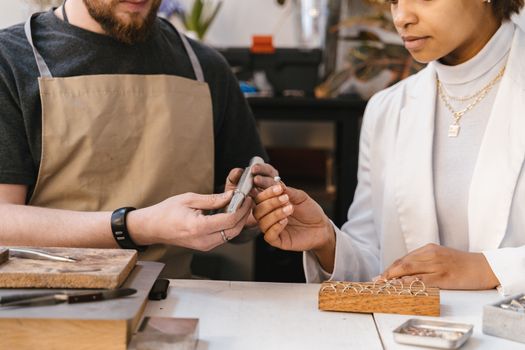 Photo: AI25.Studio Studio / Pexels
While at-home methods provide a good starting point, nothing beats the precision and expertise of a professional jeweler when it comes to knowing how to choose the right ring size. Visiting a reputable jewelry store for a sizing consultation offers several distinct advantages, ensuring you get the most accurate and comfortable fit possible for your cherished piece.
Jewelers use specialized tools, primarily a set of calibrated metal ring sizers. These sizers come in full and half sizes, and sometimes even quarter sizes, allowing for extremely precise measurements. Unlike string or paper, these metal sizers mimic the feel and weight of an actual ring, giving you a much better sense of how the chosen size will truly sit on your finger. A professional will have you try on several sizers, starting with an approximate size and then narrowing it down. They'll observe how the ring slides over your knuckle, how it rests at the base of your finger, and how it feels as you move your hand. This tactile experience is crucial for determining comfort and security.
Beyond the tools, the jeweler's experience is invaluable. They understand the nuances that influence ring fit. For instance, they'll know to consider the specific design of the ring you're interested in. As mentioned earlier, wider bands often require a larger size than narrow ones. A jeweler can advise whether the ring's profile – flat, domed, or comfort fit – will affect the sizing. They can also account for the material; while metal rings are generally straightforward, certain alternative materials like ceramic or tungsten cannot be resized, making the initial measurement even more critical.
Furthermore, a professional can assess your finger's unique characteristics. Do you have prominent knuckles? Are your fingers prone to significant swelling? A skilled jeweler will take these factors into account, perhaps recommending a slightly larger size that clears the knuckle but can be secured with sizing beads, or suggesting a size that accommodates natural fluctuations. They can also help you understand the appropriate 'tightness' – a ring should be snug enough not to fall off but loose enough to slide over the knuckle with a little resistance and without excessive force. It should also be comfortable enough for daily wear without pinching or leaving deep indentations.
Another benefit of professional sizing is the opportunity to try on different widths and styles. You might find that a ring you thought would fit a certain way actually requires a different size due to its overall design. This hands-on experience is impossible to replicate with at-home methods. Many jewelers offer this service for free, making it an essential step, especially for significant purchases like engagement or wedding rings. It's a small investment of time that can save you the potential hassle and cost of resizing down the line. Remember, finding the perfect
jewelry often starts with the perfect fit. Always seek professional advice for the most accurate results.
Essential Tips and Common Mistakes to Avoid When Sizing Your Ring
 Photo: Souvik Bhowmik / Pexels
Even with the best tools and intentions, mistakes can happen when trying to figure out how to choose the right ring size. Being aware of common pitfalls and employing strategic tips can significantly improve your chances of getting it right the first time.
**Tips for Success:**
* **Measure Multiple Times:** As discussed, finger size fluctuates. Measure at least three to four times throughout the day, and ideally on different days, to get a consistent average. The end of the day is generally best, as fingers are at their largest.
* **Consider Temperature:** Avoid measuring your fingers when they are extremely cold or hot. Cold fingers shrink, and hot fingers swell. Aim for a comfortable, room-temperature environment.
* **Account for Knuckles:** If your knuckle is noticeably larger than the base of your finger, measure both. The ring needs to be large enough to slide over the knuckle but not so loose that it spins freely or falls off at the base. Sometimes, sizing beads or a spring insert can help with this.
* **Factor in Band Width:** Always remember that wider bands (6mm or more) generally require a half to full size larger than narrow bands. A professional jeweler can confirm this.
* **Think About Ring Stacking:** If you plan to wear multiple rings on the same finger, they will collectively take up more space and might require a slightly larger size than a single ring.
* **Visit Multiple Jewelers:** If you're unsure or getting conflicting results, try visiting two or three different jewelers for a professional sizing. This helps confirm consistency.
* **Err on the Side of Slightly Larger:** It's generally easier and less costly to size a ring down slightly than to size it up, especially for intricate designs or rings with stones.
**Common Mistakes to Avoid:**
* **Measuring When Fingers are Swollen or Cold:** This is perhaps the most frequent error. Avoid measuring after intense exercise, during pregnancy (unless it's for a temporary ring), or after consuming a lot of salt. Also, don't measure first thing in the morning, as fingers can be slightly swollen from sleep.
* **Using Stretchy Materials:** Never use stretchy string or elastic to measure your finger. It will give you an inaccurate, usually smaller, reading.
* **Not Checking Printable Sizers for Scale:** If using a printable sizer, always verify that it has been printed at 100% scale by measuring a reference line with a ruler.
* **Ignoring Knuckle Size:** A ring that fits the base of your finger perfectly but can't pass your knuckle is useless. Always ensure it can clear the knuckle without causing pain.
* **Assuming All Rings of the Same Size Fit Identically:** As mentioned, band width, style (e.g., comfort fit vs. standard), and even the exact manufacturing process can lead to subtle differences in how a ring feels, even if it's technically the same size.
* **Measuring Too Loosely or Too Tightly:** The measurement should be snug but comfortable. If it's too loose, the ring could fall off. If it's too tight, it will be uncomfortable and potentially restrict circulation.
* **Not Considering Resizing Limitations:** Some rings, particularly those made of certain alternative metals (tungsten, titanium, ceramic), or rings with intricate pave settings or full eternity bands, cannot be resized or are extremely difficult and costly to resize. Ensure your initial measurement is as accurate as possible for these types of rings.
